The fictional nature of memory and stories
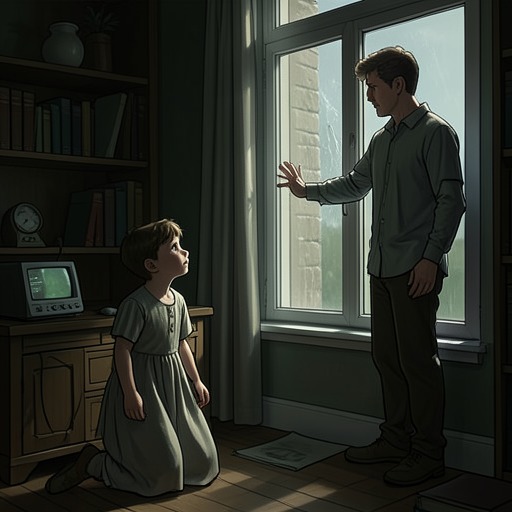
I'm Thinking of Ending ThingsThe fictional nature of memory and stories names a central tension in the novel: people need stories to recall, interpret, and share experience, yet every retelling reshapes what it claims to preserve. Jake argues that memory is edited and changeable, while reality occurs only once. The narrator’s increasingly self-conscious account, Jake’s reflection on his childhood photograph, and the final imagining of a life that never happened turn that tension into a question of personal identity as well as narrative truth.
Remembering While Telling
As The narrator recounts an earlier encounter involving Doug, the story pauses over its own telling. She has remembered the exchange in which Doug handed her the keys, the force with which she caught them against her stomach, and the large letter J on the key chain. Rather than treating such precision as proof that recollection is reliable, the scene makes the details themselves an object of uncertainty: The narrator wonders whether remembering and reporting so much is strange, or whether it makes her story boring. Her concern is not simply whether a remembered event occurred, but how a listener receives a memory once it has been arranged as narrative.
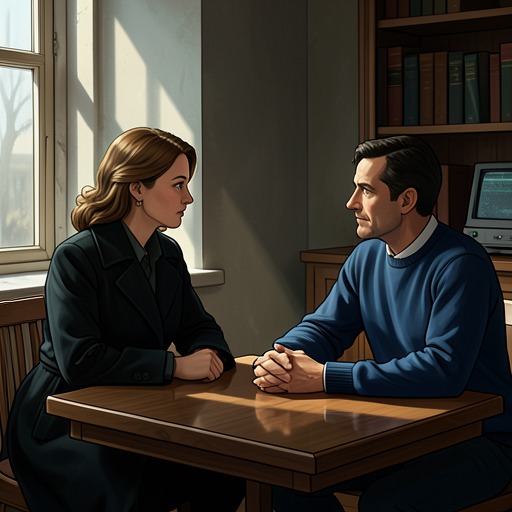
Jake responds by urging her to continue, describing memory as fiction that has been heavily edited. The narrator does not wholly accept the claim, though she acknowledges what he means. That small resistance matters. The novel does not present the instability of memory as a settled theory that makes all accounts equally false; it stages a disagreement between confidence in remembered particulars and awareness that recollection is never an untouched recording. The exchange also makes listening part of the process: Jake’s permission to go on sustains the telling even as his account of memory unsettles its authority.
Retelling and the Singular Event
When The narrator later asks what Jake meant by calling memory fiction, he describes a memory as something that becomes its own version each time it is recalled, rather than an absolute record. He links that changeability to stories: both memories and fictions are recalled and retold, and stories help people learn and understand one another. His distinction is not that stories are useless because they are invented. Their usefulness lies precisely in how they give experience a form that can be communicated. Against that repeated process of telling, Jake sets the singularity of reality: “Reality happens only once.”
The contrast does not resolve into a simple opposition between false stories and true events. When The narrator asks whether it matters if the account she has just told was made up or actually happened, Jake answers, “Every story is made up. Even the real ones.” The phrase collapses the reassuring boundary between factual subject matter and fictional construction without claiming that the underlying events are interchangeable. A real event can happen once; its later versions are stories, selected and shaped in retrospect. The scene therefore distinguishes the occurrence from the account of it, while insisting that people encounter and understand the occurrence through accounts.
The conversation also draws attention to the novel’s form. The narrator’s recollection is presented in detail, interrupted by questions about the reliability and worth of telling it, then reconsidered through Jake’s ideas. The reader receives not just a remembered episode but a record of someone testing how that episode becomes a story. The uncertainty is built into the telling rather than added as a verdict from outside it.
The Problem of Personal Continuity
The same problem appears in Jake’s story about a photograph he keeps at his desk in the lab: it shows him at five, with curly blond hair and chubby cheeks, and is the only photograph of himself he keeps there. Jake likes it because the child is him, although his present appearance is completely different. He also points to the body’s material change: the cells represented in the image have died, been shed, and been replaced. The photograph offers a fixed image, but the person who claims it as his own has not remained physically fixed.
The narrator’s reflection pushes the example toward a question of continuity. How can Jake remain aware of being the child in the photograph if the body has changed so completely? She anticipates that he might answer by referring to proteins, but the passage does not supply a final resolution. Instead, it places the remembered self alongside the visible child and the present body, each connected to Jake yet not identical in appearance or substance. The photograph becomes a concrete counterpart to the changing memory: both preserve a relation to a past self without making that past self simply present again.
The narrator then compares bodily change to the life of a relationship, describing structures that change, repeat, tire, age, and deplete. Bodies and relationships alike may become ill and recover, or become ill and worsen, without anyone knowing when or why. This comparison keeps continuity from becoming a purely abstract puzzle. What persists is entangled with change, repetition, and uncertainty; the fact that people carry on does not make their successive states identical.
The Unlived Story
Near the novel’s end, a recollection of The narrator and Jake at the Pub returns to the theme in a changed light. Jake is described as listening to his team discuss questions without speaking, yet still participating and thinking. He takes small sips of beer and repeatedly sniffs the back of his hand, a habitual gesture associated with concentration or relaxation. His presence among other people is presented as difficult and significant. The memory preserves these small observations, but its later position makes the act of preserving them part of a larger effort to tell what the meeting meant.
The account then turns to what did not happen. Jake wrote his number on a napkin but could not give it to the woman he had met. He hoped they might meet again, but the chance never came; the passage states that he had to make it happen and that he wrote about her and about an imagined “us.” The narrative opens a series of counterfactual possibilities: a call, another meeting, a date, a road trip, a kiss, or a visit to the house where he was raised, perhaps with an ice-cream stop on the way home. Each possibility gains emotional shape through telling, but the text marks them as unrealized. The woman would likely have forgotten the brief meeting; she does not know that the imagined “we” exists, and the burden of that story belongs to the ones who continue to carry it.
The passage’s shifts among “She,” “He,” “We,” and “Me” further unsettle the boundary between the remembered encounter and the later story built around it. The imagined relationship cannot be treated as a shared history, because the other person did not participate in it and the proposed future never occurred. Yet the story has consequences for the one who keeps thinking and writing about it. The closing reflections do not make the counterfactuals real; they show how narration can make an absence meaningful. In that sense, Jake’s claim that reality happens only once stands beside, rather than cancels, the power of the stories people make from what happened—and from what never did.